


Bahmani Sultan Ibrahim Adill Shah II of Bijapur in Karantaka fell in love with Gor Banjara dancer Rambni bhai, alias Rambha. They had in common, their claimed decent from Queen Esther of Persia (490-460 B.C).
This article has 29 foot-notes. Press the foot note number, and get the enlarged story with illustrations.
After 15 year of research, it is now possible to present a narrative that is very likely the correct version of history. The work of finding the origin of Gor Banjara tribe in India has been a long journey. Without backing from governmental sources, and hardly any private funds, it has been like the search for a needle in a haystack. Many circumstantial evidences have been presented through the years. But the last few pieces in the ancient puzzle have been missing.
The last piece looks like a true love story. Rambhavati, or in Gormati language, Rambni bhai, meaning a noble female, a Lambada dancer from the Gor´s. The emergence of Islam had made both her and her Sultan lover move eastwards from Persia and into Hindustan. Also her tribe ran away from Persia. He was elevated to power. A mighty sultan, a suffi, a lover of music and art, a rebel against the salafist sultan of Delhi. She an illiterate artist, he well versed in history, claiming to be a successor of Queen Esther of Persia. 1. The Bahmani sultan of Bijapur in Karnataka in Southern India. Ibrahim Adill Shah II. The official story of Rambni bhai alias Rambha, seems to have been twisted. Based on oral traditions. I had the honor of meting Dr. Arvind Jalgi in Goa. He told me that the Islamic narrative of history seems to be incorrect. In his youth he had traveled to the borders between Goa and Karnataka. There he met Banjara elders in a tanda, who claimed Rambha was a dancing beauty from their people. A young Lamani, the name of one of the main arms of the Gor Banjara people. Dr. Jalgi´s research had been quoted in a book about the pre Portuguese history of the state of Goa 2, ruled by the Adil Shah dynasty of Bijapur. But Dr. Jalgi could not record the names, neither of the tanda nor of the elders.
Oral traditions stands strong in the Gor Banjara community. The known history of this tribal community told from father to son with absolute accuracy. That is why the stories have not changed through the ages. Today the same story are told by people living hundreds of kilometers apart. Could it be possible that the story of Rambha, still lived in the mind of the tanda elders off the city of Bijapur? A young Banjara with the name Pavan Lunavath from Mahbubabad in Telangana picked up the challenge. He traveled from the Himalayas to the court of the Sultans to examine, a distance of 2.800 kilometers. And there she was, Rambavati, or Ramani. Her memory still kept in the hearts of two Banjara elders.
“ Muslims came and kidnapped our Rambni bhai. A nobel man, a king. We wanted to kill that king, but we never did!.” Tolaram Rathod Bhukiya, from Devur Tanda 3, approximately 55 kilometers south of Bijapur looks like he still can feel the pain. He is a Banjara priest, from the kingly class of Nayaks. His surname is biblical. Bukiya 4. was a temple priest in King Solomons temple ca. 1.000 B.C. A descent of prophet Samuel, from the Israeli tribe of Levi.
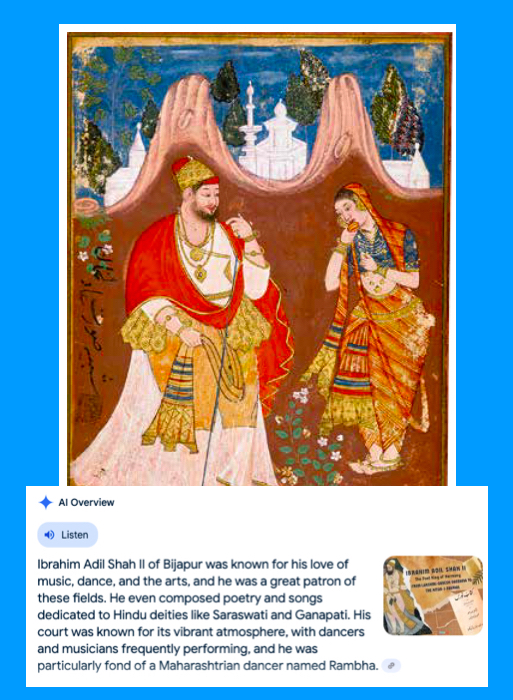
We can not be hundred per cent sure that Artificial Intelligence will guide us correctly. AI tells us that Sultan Ibrahim Adill Shah was very found of a dancers in his harem. One of them supposed to have come from Maharashtra 5., and could have been a captive from the Marathas. Strangely enough, this court dancer was removed from an ancient painting of the couple. She dressed up in a Maratha custom 6. Did the later Sultans change the story? And if so, why? If Ibrahim had fallen in love with a girl considered a sudra, and made her his mistress, it would have been very improper. Ibrahim was also considered a soft heretic, by his community. A weak suffi. Again to quote AI: Ibrahim brought in marginalized class of people to the parties in his court 7. The official story in Bijapur today, is that Rambha was the mistress of Muhammad Adill Shah, the 7th ruler of the Adill Shah dynasty. The guides at Gol Gumbaz will tell you that Rambha was a noble dancer from Sri Lanka, she is laid to rest next to the Sultan and his wife inside the tomb of Gol Gumbaz 8.
From the Gor Banjara perspective a love story between a Muslim and a Banjara girl, would lead to her excommunication from the tanda and the whole community. I have my self been a witness to a “kidnapping story” from a tanda near Gadag. A girl I know personally disappeared. “A Muslim came to the tanda, and kidnapped her”. Some people in the tanda spoke about revenge. I found the girl inside a Muslim enclave, some 50 kilometers away. She had fallen in love with a migrant labor boy, and ran away with him.
Even today, Hadasha, the beautiful Jewish girl in ancient Susa in Persia, is not proper Torah for Orthodox Jews. The young woman from the tribe of Banjamin married a non-Jew. The Emperor of Persia. Even in Israel today, such a girl would ran the risk of being excommunicated. But because she rescued her people from a planned Holocaust in ca. 460 B.C in Persia, they have to accept her. And they do celebrate Purim. Rambhavati, alias Ramani in the Goa Banjara community seems to be a local queen Esther story. Together with all the other pieces in the puzzle they now make a perfect picture. And it’s beautiful.
A love story with its origin in Persia
The Ibrahim and Ramani love story has a fascinated background from Persia. Ibrahims links to Persia can not be questioned. The Bahmani sultanate is a Persianate sultanate in Southern India. But what about Rambhavati, alias Rambni bhai? How is she linked to Persia? As a female from an illiterate community, there are no written records of her origin. But history has left us with other fingerprints. One of the best clues of the present of Gor Banjaras are places named “tanda” placed along ancient caravan routs 9. Like along the Nile river in Egypt, and as fare west as the Atlas Mountains of Morocco 10. Lamanis people in India call them selves “Gors”. Gor 11. was the ancient capital of Sassanian king King Ardashir I . The people of Persia who refused to convert to Islam in the 7th century, ran away eastwards to the mountains of Afghanistan. There you will find the province of Ghor 12. Well known Banjara historian, Motiraj Rathod from Maharashtra has in his book “Ancient history of Gor Banjara”, documented that Gor´s migrated into India from Afghanistan. 12. When Islam concurred Ghor in the 12th century, those of the Gor people who refused to convert, escaped further south east and into the tandas of the Indus Valley 13.
Could it be that both Ibrahim and Rambni bhai are descendants of the tribes of Israel? And that they are representatives of the ancient Jewish community in Persia? Are there evidences of such connections?
Let us start with Ibrahim.
The founder of the Bahami breakaway kingdom from the Delhi Sultanate, Ala-ud-Din Bahman Shah, claimed he was of decent of Bahman, the son of Emperor Xerex I and his Jewish queen Esther (460 B.C). This claim is based on Persian traditions, and not a direct historian blood line. Again we will consult artificial intelligence (AI). “Bahman 14., also known as Artaxerxes I, is the son of Xerxes I in Persian tradition and history. He is often equated with Artaxerxes I of the Achaemenid Empire in historical and literary texts. The equation of Bahman with Artaxerxes I is a subject of scholarly discussion, with some historians and literary scholars making a direct correlation between the two figures”. The Bahmani´s claimed to be successors of Sassanian empire king Bahram Gur (420 A.D to 438) He was the Son of Queen Shushandukht, a daughter of the leader of the Jewish community in Persia, Rabbi Huna bar Nathan. The second Sassanian king Shapur I founded the city of Bishapur in 266 A.D. He reigned, after Ardashir I, who formed the city of Gor. Bishapur city dominion was a cross road in Persia, lasted till the Arab conquest in the 7th century, in the age of Muhammad. The Bahmani Sultanate broke into five smaller independent sultanates, Bijapur sultanate on of them. Its founder Yousuf Adill Shall was by the Portuguese in Goa called “The Sabaio”. In the ancient Castilian langue, “Sabaiorios” 15.16. , mean keeper of the Sabbath. I have highlighter his background as a slave from Georgia in my book “The Golden age of Goa”. The sultan who let Jews build synagogues in pre-Portuguese Goa. He him self very likely a decent from the House of Israel in exile in Persia, enslaved by a Muslim.
What about the Gor´s of Karnataka? Have they preserved any Jewish cultural connections, which can be identified today?
Dr. Eyal Beéri from Ariel University in Israel visited India in august 2023. He found present day Jewish customs in Banjara Tandas around the city of Gadag, 180 kilometer south of Bijapur. There are a number of surprisingly similar Banjara-Jewish customs and they all come from the Banjara kitchen such as: Rules for consumption of goat and chicken, the way the animal is slaughtered, covering the blood after slaughter, separation between goat and milk dishes and two-hour fasts from consuming dairy foods, and similarly, an hour fast after eating chicken. These customs are also found in the Gor Banjara cuisine. Also the Gor Banjara priests follows “Nasreen traditions”. 17. They are neither permitted to drink alcohol nor to cut their hair. The Gor´s also offer blood of goats during religious festivals, like the Hebrews did in Egypt and Sinai desert. 18.
The similar geographical triangles of Persia and Karnataka
Kings chroniclers have gifted us solid narratives to World history. But they have no monopoly to the truth. The voices of those who lost wars have hardly been treated objectively in the historical records. Marginalized groups and tribal tribal people have maintained their cultural identity on folklore and oral traditions, not always acknowledged by the Academics. A voice like Tolaram Rathod Bhukiya has never before faced a researcher in history of the Goa Banjaras. Another voice is french businessman and adventurist Jean-Baptiste Tavernier (1605–1689) 19. He spoke to Jews in the Persian city of Shiraz 20., claiming to be decent from the tribe of Levi. In India he observed Gor Banjaras who lifted up a snake on a stake in the wilderness, as they halted one of their caravans. Tavernier saw Banjara females dancing around the snake on the stake three times 21. You can not fail to see the similarities with the snake of Moses, Nehushtan 22. Placing this tradition solidly beyond the formation of the Davidic kingdom 1.000 B.C, and into the wilderness of Mount Nebo, and the Hebrews wandering in the desert of Sinai almost 4.000 years ago. Nehusthan was destroyed in the 8th century B.C 23. Interestingly enough, this Hebrew levitical religious tradition seems to have continued in India up to the 17th century A.D.
To connect the dots, you have to looks at the similarities between a small geographical triangle in Persia 24., and the copy made by the Bahmani sultans set up in Karnataka in India. In Persia you find Jews who claimed to be decent of Levi, one of the 12 sons of Jacob, in the city of Shiraz. You find the ancient Sassanian city of Gor, today named Firuzabad. And close by you can locate the ruins of the city of Bishapur. In Karnataka the 14th century A.D. Persian sultan set up a copy 25. Hardly 30 kilometers from the city of Bijapur you find the ruins of Firozabad. And in the villages around them both, you can have chai with the traveling tribe of Gor Banjaras. There are some few records of females in the official world history, most of them queens in the courts of kings. Never underestimate the influence and powers of a beautiful woman. But the life and viewpoints of women are often neglected in the academic World. Like Chandi bai. She is the grandmother of one young adult in team Pavan. The team checked her dress code and ornaments, all of these items a witness of the deepest pockets of history. One of Chandi bai´s neckless display a silver-plate with place for five jewel stones 26. The circles represent each of her sons. The similarities to the breastplate of the High priest in king Solomon temple 27. can not be ignored. Gor Banjara priest Tolaram Rathod Bhukiya shared with Pavan and his team, what I surely a biblical story. Illiterate Rathod Bhukiya recalled their ancient king wrestling with God the whole night. You can not fail to understand, that his forefathers shared with their sons, the struggle of biblical Jacob from the book of Genesis 28.
How do we know that the Banjaras refused to convert to Islam, and ran away from ancient Afghanistan, unlike the Patans, who converted?
The Folklore university of Karnataka in Haveri has published a book with the proverbs of the Banjaras, based on oral traditions. There are more than 50 proverbs in this book who are similar to the proverbs of king Solomon, found in the Hebrew Bible, including proverbs similar to what is found in the New Testament. One of these proverbs tell the real story. Proverb: 944: “See all gods from the front, but see Allah from the back” 29. Like all other tribes of Israel, like Jews presented in the modern day state of Israel, the majority of Gor´s have always refused to convert, but rather managed to escape the sword and look for another shelter.
Foot notes:
1 Queen Esther of Persia
2 Pre Portuguese history of the state of Goa
3 Devur Tanda of Karnataka
4 Bukkyia
5 Rambha called Mahrarashtrian
6 Ibrahim with claimed to be Rambha
7 Ibrahim had gypsy dancer in his court.
8 Claimed tomb of Rambha in Gol Gumbaz
9 The Banjara World map
10 Tandas in Atlas Mountains in Morocco
11 The ancient city of Gor
12 The province of Ghor
13 Tandas in the Indus Valley
14 Bahman of Persia
15,16 Sabaio and Sabaio-rios
17 The observations of Dr. Eyal Béeri from Ariel University, Israel.
18.Sacrifice of blood of goats
19 Jean-Baptiste Tavernier (1605-1689) saw Banjara worship snake of Moses
20 Jews in the Persian city of Shiraz
21 Snake of Moses called Nehusthan
22 The biblical snake of bronze
23 Nehustan destroyed in the 8th century B.C
24 Geographical triangle of Persia.
25 Geographical Persian copy in Karnataka.
26, 27 Silver neckless of Chandi bai and breastplate of high priest
28 Jacob wrestles with God
29 See all gods from front, Allah from the back.
By Ivar Fjeld
22.06.25
Gadag.
Translation of this article into the Telugu language
Pavan Lunavath compering Banjara names with Hebrew names.
 The Israeli origin of Gor Banjaras
Leave a comment